
Cannabis Insights
What is a cannabis boutique dispensary?
Discover what is a cannabis boutique dispensary. Enjoy personalized service and a curated shopping experience in the world of cannabis.
CannaRadar Team
Discover how to compare cannabis store locations in Canada effectively. Evaluate accessibility, pricing, product range, and more to find the best fit.


Comparing cannabis store locations means evaluating each retailer across five core factors: accessibility, licensed status, product range, pricing, and customer service. Get one of those wrong and you could end up with a sketchy product, a 45-minute parking nightmare, or a price tag that makes your eyes water. Canada’s legal cannabis market now lists over 2,071 businesses on directories like Cannaradar, so the options are genuinely plentiful. The challenge is not finding a store. The challenge is finding the right one for you.
A smart cannabis store comparison starts with five questions, not one. Most people ask “what’s closest?” and stop there. That’s like choosing a restaurant based only on which one you can see from your window.
Proximity matters, but trip friction matters more. A store five minutes farther away with express pickup and easy parking can be a faster visit than the one around the corner with a packed lot and a queue at the door. Check hours too. A dispensary that closes at 8:00 PM is useless if you finish work at 7:30 PM.
Every legal cannabis retailer in Canada must hold a valid provincial licence. Checking that licence number on your province’s official government portal takes about two minutes and tells you whether the store is operating legally. A licensed store sells lab-tested products under regulated standards. An unlicensed one does not.
Local stores carry what fits on their shelves. Online dispensaries typically carry far larger catalogues, including rare strains, edibles, and concentrates that smaller storefronts never stock. If you have a specific product in mind, check the menu before you make the trip.

Sticker price is not total price. Tax, delivery fees, and minimum order thresholds all affect what you actually pay. A bulk deal online can evaporate once you add a $15 shipping fee and a $50 minimum order.
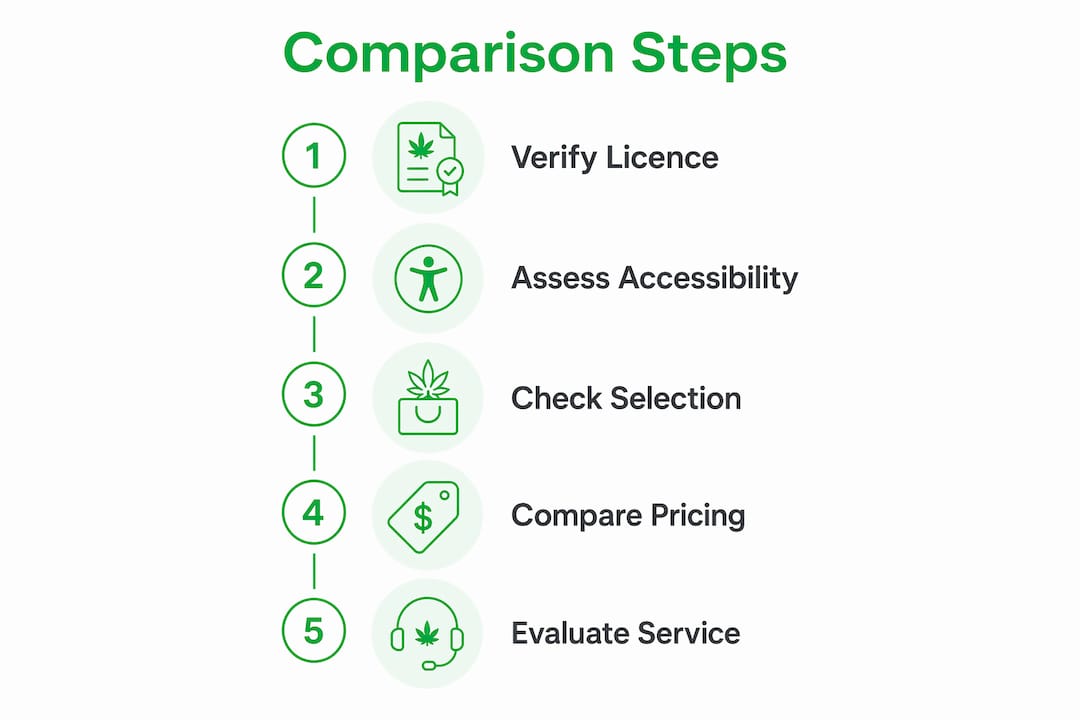
Some people want a knowledgeable budtender to walk them through options. Others want to order in their pyjamas and have it arrive on Thursday. Neither preference is wrong. Know which one you are before you start comparing.
Pro Tip: Write down your top two priorities before you start comparing stores. It sounds obvious, but most people skip this step and end up choosing based on whichever store has the flashiest website.
Verifying a cannabis store’s licence is the single most important step in any cannabis store comparison. Licence numbers on official portals confirm that a retailer meets provincial standards for product safety, staff training, and consumer protection. Skipping this step is how people end up buying unregulated products with no quality control.
Here is how to check:
Find the store’s licence number. It should be displayed on the storefront, on the website, or on the receipt. If a store refuses to share it, that is a red flag.
Visit your provincial regulator’s portal. In British Columbia, that is the BC government’s cannabis licence database. In Ontario, it is the Alcohol and Gaming Commission of Ontario (AGCO) registry. Each province maintains its own public list.
Search the licence number. Confirm the name, address, and status match the store you are evaluating. An expired or suspended licence is as bad as no licence at all.
Look for the licensed retailer decal. Legitimate stores display an official provincial decal on the storefront window. No decal is not automatically a dealbreaker, but it warrants a closer look.
Report suspicious operators. If a store cannot produce a licence number or shows signs of illegal operation, report it to your provincial cannabis regulator. This protects you and every other shopper in your community.
Verifying licence numbers via official government portals is the most reliable indicator of product safety and professional service. Licensed stores sell lab-tested products. That means no mystery pesticides, no unregulated THC levels, and no guessing what you actually bought.
The pricing and selection gap between online and in-person cannabis shopping is real, and it runs in both directions depending on what you need.
Online dispensaries typically deliver within 1–3 days and carry larger catalogues than most physical stores. That delivery window matters if you are planning ahead. It is a problem if you need something tonight.
Factor | Local store | Online dispensary |
|---|---|---|
Wait time | Immediate (0 days) | 1–3 business days |
Product range | Limited to shelf space | Typically much larger |
Pricing | Standard retail | Often lower with bulk deals |
Extra costs | None beyond tax | Shipping fees, order minimums |
Personal service | In-person budtender | Online chat or email |
Best for | Urgency, first-timers | Regulars, specific products |
Hidden shipping minimums and delivery fees can negate bulk purchase savings entirely. Always calculate product price plus tax plus shipping before deciding that the online deal is better.
The smarter approach is to use both. Buy your everyday staples online when you can plan ahead. Use a trusted local store for same-day needs or when you want a budtender’s recommendation on something new.
Pro Tip: Before placing an online order, check whether the dispensary has a minimum order threshold. A $30 product with a $50 minimum means you are spending $50 whether you want to or not.
Convenience is not just about distance. Experienced shoppers evaluate location by total trip friction, which includes parking ease, traffic patterns, and pickup speed. A store that is technically closer but requires circling the block three times is not actually convenient.
Here is what to assess before committing to a regular spot:
Route fit. Does the store sit naturally on your commute or errands route? A store that requires a dedicated trip costs more time than one you pass anyway.
Parking and access. Street parking, dedicated lots, and bike racks all affect how easy a visit actually is. Check Google Street View before your first trip.
Pickup speed. Some stores offer express or pre-order pickup that cuts wait time dramatically. If you are time-pressed, this matters more than price.
Customer reviews. Look for stores with Google ratings of 4.6 stars or higher and at least 215 verified reviews. High ratings with a large review count signal consistent quality, not just a few good days.
Budtender quality. A knowledgeable budtender is worth more than a loyalty points card. If staff can answer questions about terpene profiles, dosing, and strain effects, that store is worth a slight premium.
Promotions and loyalty programmes. Promotions of 50–60% off first visits are common across Canadian dispensaries. Price-shopping across stores on your first visit often beats sticking with one loyalty programme.
The best cannabis dispensaries near you are not always the ones with the biggest signs. They are the ones that make every visit feel easy and every purchase feel informed.
Segmenting your needs between local and online criteria avoids muddled comparisons. A local store and an online dispensary are not the same product. Comparing them on identical criteria is like comparing a taxi to a mail-order service. Use this process instead.
List your priorities. Write down what matters most: immediacy, price, product selection, or in-person guidance. Rank them. Your top priority should drive your final decision.
Gather data. Visit each store’s website. Check their menu, hours, and pricing. Read recent Google reviews. Verify their licence on your provincial portal.
Score each store. Build a simple table with your top four criteria as columns. Rate each store out of five for each factor. The highest total score is your starting point.
Make a test visit or order. No amount of research replaces a first-hand experience. Visit the store or place a small online order. Assess the actual service, product quality, and overall feel.
Reassess as your needs change. The store that suits you as a first-time buyer may not suit you six months later when you know exactly what strain you want and care more about price than guidance.
The best dispensary depends on your priorities, whether that is government pricing consistency or curated experiences in private retail. There is no universal answer. There is only the right answer for you, right now.
The most effective way to compare cannabis store locations is to evaluate legitimacy first, then weigh accessibility, pricing, and product range against your personal priorities.
Point | Details |
|---|---|
Verify the licence first | Check provincial government portals to confirm a store is legally authorised before anything else. |
Calculate total cost | Add tax, shipping fees, and order minimums to compare true prices between online and local options. |
Assess trip friction | Evaluate parking, route fit, and pickup speed, not just distance from your front door. |
Check verified reviews | Stores with 4.6 stars or higher and at least 215 reviews signal consistent, reliable quality. |
Match the format to your need | Use local stores for same-day purchases and online dispensaries for selection and bulk savings. |
I’ve seen a lot of people make the same mistake: they Google “best cannabis dispensaries near me,” click the first result with a decent star rating, and call it done. That approach works until it doesn’t, usually when they show up to a store that’s technically open but has a 20-minute queue, no parking, and ran out of the product they wanted.
The thing that actually separates a good cannabis shopping experience from a frustrating one is doing the licence check. I know it sounds like homework, and it kind of is. But buying from an unlicensed store is not just a legal grey area. It is a product safety issue. Unregulated cannabis has no mandatory lab testing. You genuinely do not know what you are getting.
The other mistake I see constantly is treating proximity as the only variable. I once drove past a closer store to use one that was five minutes farther because it had express pickup and a parking lot I could actually get into. That “farther” store saved me 15 minutes total. Distance on a map and time in real life are two very different things.
My honest advice: use a cannabis store locator like Cannaradar to pull up verified listings in your city, cross-reference the licence numbers, read the reviews, and then make your first visit a small test. You will know within one trip whether a store deserves your regular business.
— Tuan
Sorting through dozens of dispensaries, cross-checking licences, and hunting for current menus across separate websites is a lot of work for what should be a simple decision.
Cannaradar organises over 2,071 verified Canadian cannabis businesses by city and province, so you can find local dispensaries without the tab-switching marathon. Listings include menus, store details, and review information updated daily. The platform also includes a strain library if you want to research products before you walk through the door. Whether you are comparing weed shops in Vancouver or looking for delivery options in Halifax, Cannaradar gives you the information you need in one place.
Comparing cannabis store locations means evaluating dispensaries across factors like licensing, product range, pricing, and convenience to find the best fit for your needs.
Check the store’s licence number on your provincial government portal, such as the BC cannabis licence database or Ontario’s AGCO registry, to confirm it is active and legitimate.
Online dispensaries often offer lower prices and bulk deals, but hidden fees and minimums can erase those savings. Always calculate the total cost including tax and shipping.
Look for stores with a Google rating of 4.6 stars or higher and at least 215 verified reviews. That combination signals consistent quality rather than a lucky streak.
Choose a local store when you need a product the same day, want in-person budtender guidance, or are trying cannabis for the first time and have questions.
Explore more insights and deepen your cannabis knowledge with these recommended articles.
Discover what is a cannabis boutique dispensary. Enjoy personalized service and a curated shopping experience in the world of cannabis.

A weed hangover is less dramatic than an alcohol hangover, but it can still derail your morning with brain fog, dry mouth, heavy eyes, and a vague feeling that your brain has gone into power-saving mode. This Canada-first guide explains why it usually happens after late-night THC, edibles, oils, or overdoing a “small” dose, which recovery steps are actually useful, what to avoid, and how to reduce the odds of waking up groggy next time.

A weed high usually lasts 2–4 hours when smoking or vaping and 6–8 hours or longer with edibles. But the real answer depends on your dose, tolerance, metabolism, and whether you decided to eat “just one more gummy” because nothing happened after 45 minutes.
Be the first to share your thoughts!