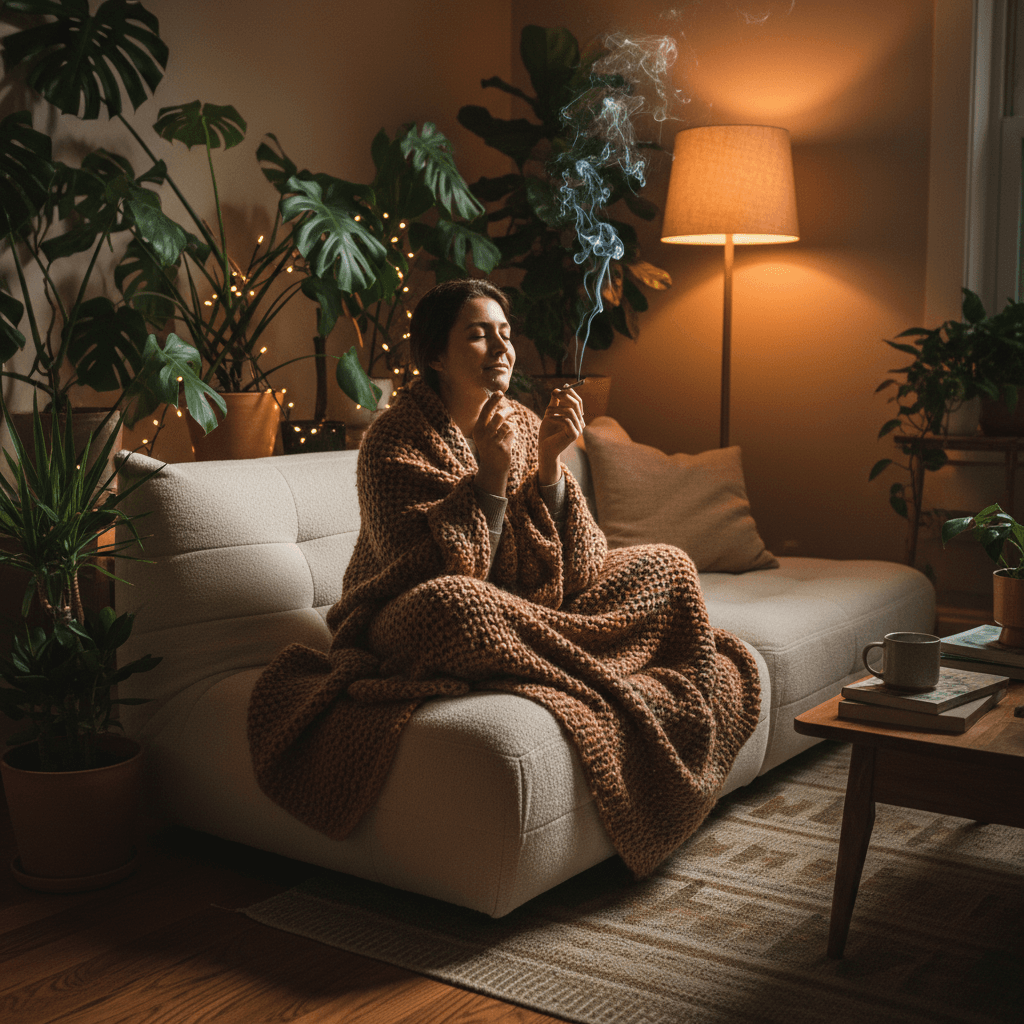
Here's a scene that plays out thousands of times a day across Canada: someone lights up after a brutal workday, sinks into the couch, and feels their jaw unclench for the first time in twelve hours. Meanwhile, across town, someone takes a hit at a party and spends the next ninety minutes convinced their heart is about to explode.
Same plant. Wildly different experiences. So what gives?
If you've ever googled "does weed help anxiety" at 2 AM, you're far from alone. Anxiety is the number-one reason Canadians say they use cannabis, according to multiple surveys — and yet it's also the number-one side effect people complain about. That contradiction isn't random. It's baked into the pharmacology.
This guide breaks down exactly what's happening in your brain, which products are more likely to calm you down versus amp you up, and how to build a personal anxiety protocol that actually works. No vague "everyone's different" cop-outs. Actual, usable information.
The Biphasic Effect: Why Dose Is Everything
Cannabis doesn't have a simple relationship with anxiety — it has a biphasic one. That's a fancy word for a U-shaped curve:
- Low doses of THC (roughly 1–5 mg) tend to reduce anxiety. Your muscles relax, ruminating thoughts quiet down, and the world feels a little less sharp-edged.
- High doses of THC (15 mg+, especially for infrequent users) tend to increase anxiety, sometimes dramatically. Racing heart, paranoid thoughts, the classic "I'm way too high" spiral.
This isn't anecdotal. A 2017 study from the University of Illinois at Chicago demonstrated this beautifully: participants given 7.5 mg of THC reported reduced stress during a mock job interview, while those given 12.5 mg reported increased negative feelings and higher stress. The difference between therapeutic and terrifying was five milligrams.
Translation: if you're using cannabis for anxiety, less is almost always more. The people who swear by it have usually figured out their sweet spot — often a dose so low their friends would laugh at it.
THC vs. CBD: The Anxiety Equation
Not all cannabinoids are created equal when it comes to your nervous system.
THC (Tetrahydrocannabinol)
THC is the main psychoactive compound, and it's both the hero and the villain of the anxiety story. At low doses, it activates CB1 receptors in the amygdala — your brain's threat-detection centre — and dials down the alarm signals. At high doses, it overstimulates those same receptors and the alarm starts blaring louder.
Think of it like volume control: a little THC turns down the static. Too much, and you've cranked it to feedback-squeal territory.
CBD (Cannabidiol)
CBD doesn't get you high, but it does something arguably more interesting for anxiety: it modulates how THC binds to CB1 receptors, essentially buffering the intensity. On its own, CBD interacts with serotonin receptors (specifically 5-HT1A) — the same system targeted by SSRIs and buspirone.
A landmark 2019 Brazilian study gave CBD to people with social anxiety disorder before a simulated public speaking test. Doses of 300 mg significantly reduced anxiety compared to placebo. The effect was comparable to pharmaceutical anxiolytics, without the sedation or dependence risk.
For anxiety specifically, CBD-dominant or balanced products (1:1 or 2:1 CBD:THC) are typically safer bets than straight high-THC flower. More on product selection below.
Want to understand the full difference between these compounds? Check out our THC vs. CBD explainer.
Terpenes: The Unsung Anxiety Modulators
If you've ever been told to "just find a good indica," the reality is more nuanced. The indica/sativa distinction is increasingly unreliable — but terpene profiles are not. These aromatic compounds do more than make your weed smell like pine or mango; they actively interact with your endocannabinoid system.
Terpenes to look for if you're anxiety-prone:
- Linalool — the same compound that makes lavender calming. Found in strains like Lavender Kush and Amnesia Haze. Shown to reduce anxiety behaviour in animal models by modulating glutamate and GABA transmission.
- Myrcene — earthy, musky. The most abundant cannabis terpene. Mildly sedative and muscle-relaxing. Common in OG Kush, Blue Dream, Granddaddy Purple.
- Beta-caryophyllene — peppery, spicy. Uniquely binds to CB2 receptors and has shown anti-anxiety effects in studies. Found in GSC (Girl Scout Cookies), Sour Diesel, and plain black pepper (yes, really — sniffing peppercorns is an old stoner trick for calming down mid-panic).
Terpenes to be cautious with:
- Limonene — citrusy and usually uplifting, which is great for depression but can be overstimulating for anxiety-prone people in high concentrations.
- Terpinolene — found in Jack Herer and similar sativas. Energizing. Not what you want when your nervous system is already revved.
Dive deeper into what terpenes are and why they matter more than THC or learn how to choose strains based on terpenes.
The Best Consumption Methods for Anxiety
How you consume cannabis matters almost as much as what you consume. Different methods hit differently — literally.
Vaping or Smoking (Fastest Onset)
Onset: 1–5 minutes. Duration: 1–3 hours.
Inhalation gives you the most control because the feedback loop is fast. Take a small puff, wait five minutes, assess. This "start low, go slow" approach is much easier when you're not waiting an hour to feel anything.
Downside: the speed can also mean a fast escalation if you overdo it. One-hitters and low-THC vape carts are your friends here.
If you're curious about devices, our dry herb vaporizer guide and smoking vs. vaping comparison break down the practical differences.
Oils and Tinctures (The Goldilocks Method)
Onset: 15–45 minutes (sublingual). Duration: 4–6 hours.
Sublingual oils — held under the tongue for 60 seconds before swallowing — are the anxiety patient's best friend. You can dose precisely (often down to 1 mg increments), the onset is moderate enough to avoid shock, and the duration is long enough that you're not re-dosing constantly.
Most licensed dispensaries and delivery services carry CBD oils and balanced THC:CBD tinctures in dropper bottles with clear mg-per-drop labeling.
Edibles (Proceed With Caution)
Onset: 45 minutes – 2 hours. Duration: 4–8 hours (sometimes longer).
Edibles are the most common source of anxiety-related cannabis horror stories, and it's almost always a dosing problem. When you eat THC, your liver converts it to 11-hydroxy-THC, which is roughly 2–3x more potent and psychoactive than inhaled THC. The slow onset tempts people to eat more before the first dose kicks in.
If you use edibles for anxiety: start at 2.5 mg THC maximum, pair with CBD, and treat waiting as part of the plan — not a sign it's not working. Our edibles timing guide and edibles dosage guide have the specifics.
Building Your Anxiety Protocol: A Step-by-Step Framework
Forget strain names. Here's a practical framework anyone can follow.
Step 1: Choose Your Cannabinoid Ratio
| Anxiety Level | Recommended Ratio | What to Expect |
|---|---|---|
| Mild / Situational | 1:1 THC:CBD | Gentle relaxation with light euphoria |
| Moderate / Generalized | 1:2 or 1:4 THC:CBD | Calming without much "high" |
| Severe / Panic-prone | CBD-only or 1:10+ | No psychoactive effects; anxiolytic |
Step 2: Pick Your Method
For acute anxiety (panic attack, sudden stress): inhalation or sublingual oil for fast onset.
For ongoing anxiety management: sublingual oil or low-dose edibles taken on a schedule (like morning CBD, small THC:CBD oil at night).
Step 3: Start Absurdly Low
THC: 1–2.5 mg to start, regardless of your tolerance with other substances.
CBD: 10–25 mg to start; therapeutic range for anxiety is typically 25–75 mg/day, though some studies show benefits up to 300 mg.
Interested in the low-dose approach? Our microdosing guide covers the sweet spot.
Step 4: Journal for Two Weeks
Seriously. Write down: product name, dose, time, anxiety level before (1–10), anxiety level one hour after, side effects. After 10–14 data points, patterns emerge that no Reddit thread can give you. You'll know your sweet spot.
Step 5: Adjust One Variable at a Time
Don't change your dose AND your product AND your method simultaneously. Tweak one thing, observe for 3–4 sessions, then adjust again. This is how you build something sustainable instead of ping-ponging between "this isn't working" and "oh god, too much."
When Cannabis Makes Anxiety Worse: Red Flags to Watch
Cannabis isn't a universal fix, and honesty about that matters. Stop or reassess if:
- You're using cannabis daily to function and feel worse without it (dependence, not treatment).
- Anxiety is increasing over time despite consistent use (could indicate your baseline anxiety needs professional attention, not plant medicine).
- You experience panic attacks exclusively while high — some brains simply don't respond well to THC, and that's not a failure.
- You're using cannabis to avoid dealing with a specific anxiety source (a toxic job, relationship, unprocessed trauma). Cannabis can be an excellent adjunct to working through things, but it's a terrible replacement for it.
If any of these hit home, talking to a healthcare provider who's cannabis-literate isn't giving up — it's leveling up. Many Canadian clinics now specialize in medical cannabis and can help dial in a protocol far more precisely than self-experimentation alone.
The Black Pepper Trick (and Other Emergency De-Escalation)
Already too high and anxious? These actually work:
- Chew or sniff black peppercorns. Beta-caryophyllene binds to CB2 receptors and can blunt THC's anxiogenic effects. Multiple stoners and at least one Neil Young interview back this up.
- Take CBD. If you have a CBD oil or tincture, 25–50 mg sublingual can help modulate the THC. It won't kill your high, but it can take the edge off within 20 minutes.
- Cold water on your wrists and face. Activates the mammalian dive reflex, slows your heart rate, and interrupts the panic feedback loop.
- Box breathing: 4 in, 4 hold, 4 out, 4 hold. Your amygdala can't maintain a full panic response when you're deliberately controlling your diaphragm.
- Change your environment. Go outside if you're inside, switch rooms, put on familiar music. Novel, overwhelming environments amplify THC anxiety.
For the full rescue guide, check out our article on what to do if you get too high.
Cannabis vs. Prescription Anxiety Meds: An Honest Comparison
This isn't an either/or — many people use both. But here's how they stack up:
| Factor | Cannabis (CBD-dominant) | SSRIs | Benzodiazepines |
|---|---|---|---|
| Onset | Minutes to hours | 2–6 weeks | 15–30 minutes |
| Addiction risk | Low (mild dependence possible) | Low | High |
| Side effects | Dry mouth, munchies, possible paranoia | Sexual dysfunction, weight gain, emotional blunting | Sedation, memory issues, rebound anxiety |
| Accessibility | Legal in Canada, no prescription needed | Prescription | Prescription (restricted) |
| Evidence quality | Promising but still emerging | Strong (decades of trials) | Strong (but risks well-documented) |
The honest truth: SSRIs have more clinical evidence behind them for generalized anxiety disorder. Cannabis — especially CBD — shows real promise and works brilliantly for some people, but we don't yet have the massive, long-term randomized controlled trials that pharmaceutical anxiety treatments do. That doesn't mean it doesn't work; it means the research is catching up to what users already know.
Practical Product Recommendations for Canadian Buyers
You don't need to become a cannabis scientist. Here's what to look for at your local dispensary or through weed delivery:
- CBD oils (1000–3000 mg bottles) — look for full-spectrum over isolate; the entourage effect matters.
- Balanced vape carts (1:1 THC:CBD) — for situational use when you need fast relief.
- Low-THC flower (under 12% THC, high CBD) — strains like Cannatonic, Harlequin, ACDC, or Pennywise.
- CBD softgels (10–25 mg per cap) — for daily supplementation without fuss.
If you're brand new, our product selection guide walks you through the dispensary experience step by step. And if you're building your cannabis vocabulary, the cannabis glossary has you covered.
The Bottom Line
Cannabis can be a genuinely effective tool for managing anxiety — but only if you treat it like a tool and not a magic wand. The people who get the best results are the ones who:
- Choose CBD-dominant or balanced ratios
- Start with absurdly low doses and titrate up slowly
- Pay attention to terpene profiles, not just strain names
- Use sublingual oils or controlled inhalation for precise dosing
- Track their experiences instead of guessing
The worst results come from grabbing the highest-THC product on the shelf and hoping for the best. That's not using cannabis for anxiety — that's gambling with your nervous system.
Be intentional. Be patient. And if cannabis isn't your thing, that's completely fine too. The goal isn't to use weed — it's to feel less anxious. Whatever gets you there wins.
Explore more in the Leaf Lab for strain details, or browse the full Green Guide for more cannabis education.